
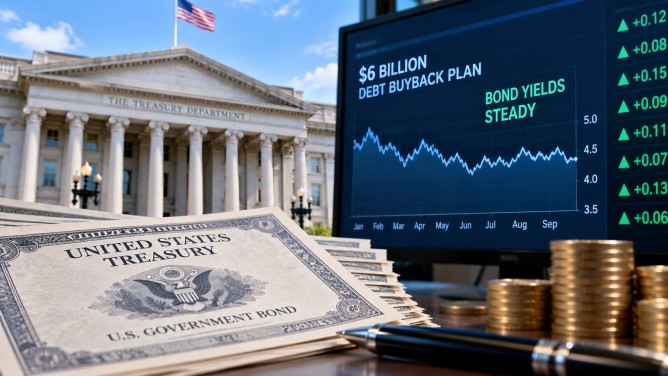
Despite the U.S. Treasury’s recent initiative to alleviate borrowing costs by repurchasing $6 billion in securities, government bond yields are on the rise. This comes as investors remain skeptical about the effectiveness of the buyback plan announced by Treasury Secretary Scott Bessent on Wednesday. The strategy, aimed at calming a selloff that has been increasing interest rates, did not have the intended effect, as the yield on 10-year Treasury bonds reached a three-year peak. Similarly, the 30-year Treasury yield surged to approximately 5.2%, a level not seen since the 2008 financial crisis.
The bond market’s unease can be attributed to ongoing inflationary pressures and the uncertainty stemming from the conflict in Iran, which have put significant stress on U.S. government debt—a financial instrument traditionally regarded as one of the world’s safest. In August, Bessent stated that the Treasury would expand its debt buyback operations to at least double the usual amount to stabilize market conditions. The plan hinges on decreasing the supply of bonds available to investors with the hope of lowering yields. However, since the announcement, yields have continued to climb.
The mounting pressure in the bond market poses a dual challenge for the U.S. Federal Reserve, which is grappling with persistent inflation. After reaching a three-year high in May, annual inflation eased to 3.4% in July but remained 0.7 percentage points higher than the previous year, exacerbated by rising energy costs. Concurrently, U.S. government debt exceeded $40 trillion in August, having doubled over the last decade. This trend in rising Treasury yields could lead to increased borrowing costs for consumers, impacting mortgage rates as well as student and auto loans.
Further complicating the economic landscape, oil prices have surged, with Brent crude surpassing $100 per barrel amid growing tensions in the Middle East. This situation puts the Federal Reserve in a precarious position as it attempts to balance controlling inflation through interest rate adjustments with political pressures from President Donald Trump, who has persistently advocated for lower rates. These dynamics underscore the complexity of navigating the current economic environment, where geopolitical factors and domestic economic policies are increasingly intertwined.