
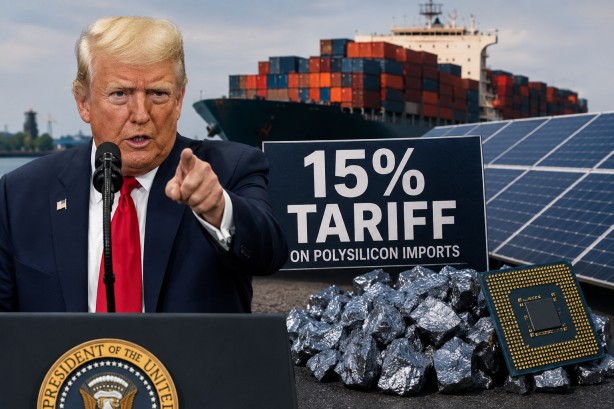
In a move to bolster domestic manufacturing and minimize dependency on Chinese imports, US President Donald Trump has announced a new 15% tariff on imported goods made from polysilicon. This material is crucial for the production of semiconductors and solar panels. The tariff is scheduled to go into effect on December 4, reflecting a broader strategy to enhance US economic and national security by encouraging local production.
Polysilicon is an ultra-pure silicon form, essential for crafting semiconductors that drive artificial intelligence systems and data centers, as well as for constructing solar cells and panels. Currently, China holds the title of the largest global producer of polysilicon. The US administration has set specific minimum import prices: $21 per kilogram for polysilicon, $100 per kilogram for polysilicon ingots and wafers, $0.22 per watt for solar cells, and $0.38 per watt for solar modules and panels. These measures aim to make domestic production more commercially viable and bolster crucial supply chains.
China has responded critically to the US’s decision, asserting that the national security rationale is being misapplied to hinder Chinese companies. They warn that such protectionist policies might adversely affect bilateral trade relations. Despite this criticism, the US administration believes the tariffs will stimulate local industry, particularly in polysilicon manufacturing, which is currently supported by two significant facilities operated by Hemlock Semiconductor in Michigan and Wacker Chemie in Tennessee.
The new tariff policy also opens the door for potential governmental incentives aimed at companies willing to invest in the domestic production of polysilicon and associated manufacturing sectors. This initiative is part of a broader effort to reinforce the economic infrastructure that is pivotal for national security, particularly as China continues to experience robust growth in exports, including electronics and AI-related products.